Data Principal Rights Under the DPDP Act: Complete Guide

- Published:
- Last Updated:
Data Principal rights under the DPDP Act give individuals greater control over how their digital personal data is collected, used, shared, corrected, erased, and managed. Compliance requires accessible request channels, proportionate identity verification, coordinated processor actions, grievance handling, documented decisions, and scalable workflows across business systems and vendors.
Overview
Data Principal rights allow individuals to understand how their digital personal data is used and request appropriate action. These rights affect consent, access, correction, updating, erasure, grievance handling, and nomination. Effective compliance requires more than a request form; it depends on data visibility, clear ownership, secure verification, processor coordination, and documented responses.
This guide explains the main Data Principal rights, individual duties, request procedures, business responsibilities, operational challenges, global differences, and practical steps for building an efficient rights-management framework.
Key Findings
- Rights requests must be simple, secure, and easy to track
- Access, correction, erasure, grievance, and nomination are central protections
- Data Principals must provide genuine information and avoid false requests
- Businesses remain accountable for processing performed by service providers
- Automation, data mapping, and audit records support scalable compliance
What Are Data Principal Rights?
Data Principal rights are legal controls that allow individuals to understand and influence how their digital personal data is processed.
Under the DPDP Act, a Data Principal is the person to whom the personal data relates. In specified situations involving children or persons with disabilities, a parent or lawful guardian may act on their behalf. The statutory foundation appears in the Ministry of Law and Justice. 2023. “The Digital Personal Data Protection Act, 2023.” Gazette of India. The Act balances personal-data protection with lawful business and public processing needs.
What Are the 7 Core Data Principal Rights Under the DPDP Act?
For practical compliance, Data Principal rights can be grouped into seven categories, although the Act does not formally list them as seven separate rights.
These rights help individuals understand, control, correct, and protect their personal data:
- 1.Right to Notice: Receive clear information about the data collected and its purpose.
- 2.Right to Manage Consent: Give, refuse, review, or withdraw consent.
- 3.Right to Access Information: Request details about personal-data processing and sharing.
- 4.Right to Correction: Correct inaccurate, incomplete, or outdated personal data.
- 5.Right to Erasure: Request deletion when continued retention is unnecessary.
- 6.Right to Grievance Redressal: Raise concerns with the Data Fiduciary or Consent Manager.
- 7.Right to Nominate: Authorise another person to exercise rights after death or incapacity.
Read also: Why Data Subject Requests
How Can Data Principals Exercise Their Rights?
Data Principals can exercise their rights through the communication channel published by the Data Fiduciary or Consent Manager.
Simple request journey includes:
- 1.Opening the organisation’s privacy-rights page
- 2.Selecting the required request type
- 3.Providing an account or contact identifier
- 4.Completing proportionate identity verification
- 5.Submitting correction, access, or erasure details
- 6.Tracking the request status
- 7.Reviewing the response or raising a grievance
Request methods should be visible and understandable. Ministry of Electronics and Information Technology. 2025. “Digital Personal Data Protection Rules, 2025.” Gazette of India. The Rules require notices to provide a link or other method through which individuals can withdraw consent, exercise rights, and make complaints.
What Duties Must Data Principals Follow?
Data Principals must exercise their rights honestly and in accordance with applicable law.
Their duties include:
- Avoiding impersonation
- Providing authentic information
- Not hiding important identity details
- Avoiding false or frivolous grievances
- Supplying accurate information for correction or erasure
- Following lawful request procedures
Read also: Shadow Processing and Unstructured Data
What Obligations Do Businesses Have When Managing Rights Requests?
Businesses must provide an accessible and accountable process for receiving, verifying, assessing, and completing Data Principal requests.
Core responsibilities include:
- Publishing clear request channels
- Providing relevant privacy contact details
- Verifying identity without excessive data collection
- Searching all relevant systems and repositories
- Coordinating action with Data Processors
- Explaining approval, partial fulfilment, or refusal
- Recording response dates and supporting evidence
- Providing an effective grievance mechanism
Read more: DPDP Act in India: Why Data Privacy Is Now a Business Imperative in 2025
What Are the Key Challenges in Data Principal Rights Management?
Managing Data Principal rights can be difficult when personal data is spread across CRM tools, emails, cloud storage, spreadsheets, backups, marketing platforms, and vendor systems. Duplicate identities, different user identifiers, and incomplete data inventories can make it hard to locate and update every record.
Other challenges include delayed vendor responses, conflicting retention requirements, manual approvals, inconsistent decisions, and limited proof that correction or deletion has been completed. Reliable data mapping and clear workflows are therefore essential for handling requests accurately and on time.
Read also: DPDP Data Minimization
How Do Data Principal Rights Compare with Global Privacy Frameworks?
DPDP rights share several principles with international privacy frameworks, but their structure and scope are not identical.
| Area | DPDP Act | Common global approach |
|---|---|---|
| Access | Processing summary and sharing information | Access to personal data and related details |
| Correction | Correction, completion, and updating | Rectification of inaccurate information |
| Erasure | Available subject to purpose and legal retention | Usually subject to defined exceptions |
| Consent | Withdrawal should be supported | Withdrawal is common under consent-based processing |
| Nomination | Expressly provided | Not standard across all privacy laws |
| Individual duties | Specifically defined | Often less expressly stated |
How Can Organisations Build a Scalable Rights Management Framework?
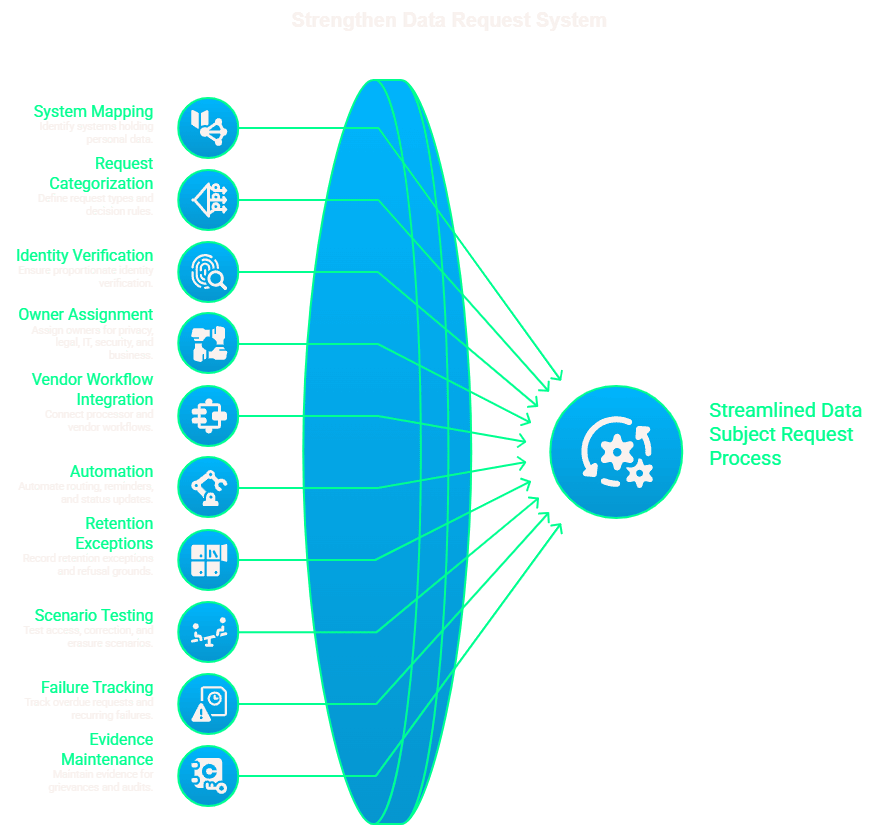
A scalable framework combines privacy governance, data discovery, workflow automation, technical controls, and measurable evidence.
Follow this implementation process:
- 1.Map systems containing personal data
- 2.Define request categories and decision rules
- 3.Establish proportionate identity verification
- 4.Assign privacy, legal, IT, security, and business owners
- 5.Connect processor and vendor workflows
- 6.Automate routing, reminders, and status updates
- 7.Record retention exceptions and refusal grounds
- 8.Test access, correction, and erasure scenarios
- 9.Track overdue requests and recurring failures
- 10.Maintain evidence for grievances and audits
National Institute of Standards and Technology. 2026. “NIST Privacy Framework 1.0 to Digital Personal Data Protection Act 2023 and Rules 2025 Crosswalk.” NIST. The crosswalk shows how structured privacy outcomes can be mapped to India’s legal requirements rather than managed as isolated tasks.
Conclusion
Data Principal rights require clear request channels, accurate data inventories, secure identity checks, processor coordination, documented decisions, and effective grievance handling. Businesses that build these capabilities into their systems and workflows can respond more consistently, reduce manual effort, and demonstrate stronger DPDP compliance.
Explore SecuRetain’s learning platform and our all courses to build practical knowledge in cybersecurity, compliance, risk management, audit, business continuity, disaster recovery, fraud management, and employee awareness training.
You can also visit our website to explore how SecuRetain helps professionals and organizations strengthen skills, improve awareness, and support continuous learning in a structured and scalable way.
FAQs
Yes. Consent can be withdrawn, and the withdrawal method should be reasonably comparable in ease to the original consent process. Processing may continue where another lawful provision permits or requires it.
No. Data may continue to be retained where it remains necessary for the specified purpose or compliance with applicable law.
Yes. A Data Principal may nominate another individual to exercise the available rights after death or incapacity.
The Data Principal must generally use the available grievance-redressal process before approaching the Data Protection Board.
The Data Fiduciary remains accountable for processing performed by a Data Processor on its behalf.
Turn privacy requirements into practical capability
Build role-ready knowledge across privacy, compliance, cybersecurity, risk management, and audit with SecuRetain.
Related reads
Keep exploring
 DPDP
DPDPLearn why data inventory for DPDP compliance is mandatory - discover personal data locations in databases, SaaS, HR systems & cloud. Complete guide to mapping, tools & audit...
 DPDP
DPDPUnder the DPDP Act, 2023, Data Subject Requests (DSRs) provide individuals (Data Principals) the right to access, correct, erase, or control their personal data...
 DPDP
DPDPUnderstand India's Personal Data Protection Act, including its scope, key terms, business duties, individual rights, enforcement, penalties, and practical DPDP compliance steps.