What Is GDPR? Rights, Risks and Compliance Checklist

- Published:
- Last Updated:
GDPR compliance requires organisations to process personal data lawfully, transparently, and securely while protecting individual rights. Effective compliance includes data mapping, lawful bases, privacy notices, security safeguards, vendor oversight, breach response, employee training, and documented evidence. These measures reduce regulatory, financial, operational, and reputational risks.
Overview
GDPR compliance means managing personal data lawfully, transparently, securely, and responsibly. It applies across data collection, storage, use, sharing, transfer, retention, and deletion.
Effective GDPR compliance requires clear governance, data mapping, individual-rights procedures, security controls, vendor oversight, employee training, and evidence that these measures work in practice.
Key Findings
- GDPR may apply to entities inside and outside the European Union
- Personal data includes direct, indirect, digital, behavioural, and sensitive information
- Lawful processing and accountability are central to GDPR compliance
- Privacy by design should be included throughout the data lifecycle
- Data mapping, DPIAs, security controls, and vendor reviews reduce compliance risks
- Serious non-compliance may lead to restrictions, reputational damage, and financial penalties
What Is GDPR and Why Does It Exist?
GDPR is the European Union regulation governing how personal data is collected, processed, stored, shared, and protected.
It exists to give individuals greater control over their information and establish consistent data protection requirements across the European Economic Area. GDPR compliance also requires entities to explain their processing activities and demonstrate accountability.
Who Does GDPR Apply To?
GDPR applies to controllers and processors established within the European Economic Area and may also apply to entities operating outside it.
It may cover overseas entities when they:
- Offer goods or services to individuals in the EEA
- Monitor the behaviour of individuals in the EEA
- Process personal data for an EEA-based entity
- Operate through an establishment located in the EEA
Read also: The Key to DPDP Compliance in an Unstructured Data World
What Types of Personal Data Does GDPR Protect?
GDPR protects any information that directly or indirectly identifies a living individual.
This can include:
- Names, addresses, phone numbers, and email addresses
- Identification, account, and employee numbers
- IP addresses, device identifiers, and cookie information
- Financial, educational, and employment records
- Location, behavioural, and online activity data
- Photographs, voice recordings, and video footage
What Are the Seven Core Principles of GDPR?
The seven GDPR principles guide how organisations should collect, use, store, protect, and manage personal data throughout its lifecycle:
- 1.Lawfulness, Fairness, and Transparency: Process data legally and explain its use clearly.
- 2.Purpose Limitation: Use data only for defined and legitimate purposes.
- 3.Data Minimisation: Collect only necessary personal data.
- 4.Accuracy: Keep data correct and updated.
- 5.Storage Limitation: Retain data only as long as needed.
- 6.Integrity and Confidentiality: Protect data from misuse, loss, and unauthorised access.
- 7.Accountability: Maintain records and evidence of GDPR compliance.
What Rights Do Individuals Have Under GDPR?
Individuals have rights that allow them to understand and influence how their personal data is processed.
Depending on the circumstances, individuals may have the right to:
- Receive clear processing information
- Access their personal data
- Correct inaccurate information
- Request deletion
- Restrict certain processing
- Receive portable copies of their data
- Object to processing
- Withdraw consent
- Challenge certain automated decisions
What Are the Main GDPR Compliance Requirements?
GDPR compliance requires entities to establish a lawful reason for processing and maintain controls that protect individuals throughout the data lifecycle.
Core requirements include:
- Identifying and documenting lawful bases
- Providing clear privacy notices
- Maintaining records of processing activities
- Managing consent where required
- Responding to individual-rights requests
- Conducting DPIAs for high-risk processing
- Governing processors and subprocessors
- Managing international data transfers
- Applying retention and deletion requirements
- Establishing breach-response procedures
Gartner highlights the need to align compliance with business strategy, third-party risk, and regulatory change. Gartner. 2024. “Gartner Survey Shows Legal & Compliance Leaders Want to Increase Their Impact on Company Strategy.” Gartner Newsroom.
Read also: 11 Steps to Jumpstart Your DPDP Compliance Program
Why Must Organisations Know and Map Their Data?
Data mapping is necessary because personal data cannot be properly protected, retained, transferred, or deleted when its location and use are unknown.
Data maps should record:
- Data categories and sources
- Processing purposes and lawful bases
- Systems and storage locations
- Internal owners and authorised users
- Vendors and subprocessors
- International transfer routes
- Retention periods
- Security safeguards
What Do Data Protection by Design and by Default Mean?
Data protection by design means including privacy requirements while planning systems, services, processes, and products. Data protection by default means applying privacy-friendly settings automatically.
| Requirement | Practical Application |
|---|---|
| Data minimisation | Collect only necessary information |
| Access control | Limit access according to job roles |
| Retention control | Define review and deletion periods |
| Privacy defaults | Disable unnecessary sharing or tracking |
| Testing safeguards | Use protected or non-production datasets |
Gartner notes that synthetic data can reduce privacy and reidentification risks when real personal data is unnecessary. Gartner. 2024. “Safeguarding Privacy with Synthetic Data.” Gartner Newsroom.
What Security Measures Does GDPR Require?
GDPR requires safeguards proportionate to the sensitivity and risk of data processing.
Key measures include:
- Encryption and pseudonymisation
- Multi-factor authentication
- Access controls
- Secure patching
- Logging and monitoring
- Backup and recovery
- Vulnerability management
- Incident response
- Vendor assessments
- Security training
How Do Legal and Financial Risks Arise Under GDPR?
GDPR risks arise when processing lacks a lawful basis, adequate transparency, suitable safeguards, valid contracts, or supporting evidence.
Common failures include:
- Excessive data collection
- Invalid consent
- Delayed rights responses
- Over-retention
- Excessive access
- Weak vendor checks
- Unlawful transfers
- Late breach reporting
Cisco Talos notes that stolen data can fuel phishing, impersonation, fraud, and other scams, increasing financial and reputational harm. Raghuprasad, Chetan. 2024. “Impact of Data Breaches Is Fueling Scam Campaigns.” Cisco Talos.
How Can You Implement GDPR in Your Organisation?
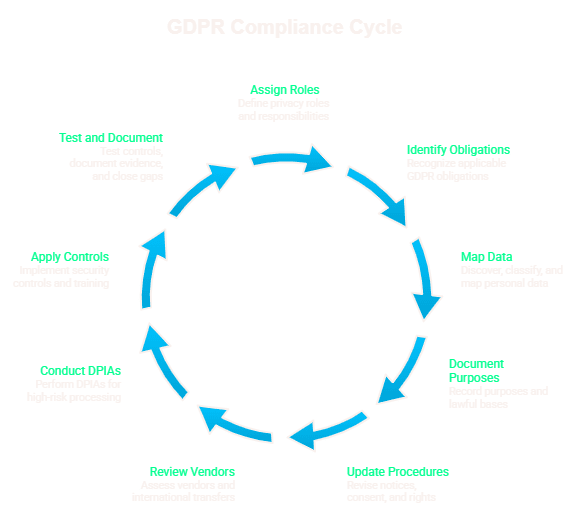
GDPR compliance should follow a structured privacy-management lifecycle.
Key steps include:
- Assign privacy roles and responsibilities
- Identify applicable GDPR obligations
- Discover, classify, and map personal data
- Document purposes and lawful bases
- Update notices, consent, and rights procedures
- Review vendors and international transfers
- Conduct DPIAs for high-risk processing
- Apply security controls and train employees
- Test controls, document evidence, and close gaps
What Should a GDPR Compliance Checklist Include?
Maintaining GDPR compliance requires a structured approach across the full personal-data lifecycle.
Key checklist areas include:
- Governance and accountability
- Data mapping and lawful processing
- Privacy notices and consent
- Individual rights and retention
- Vendor and transfer controls
- DPIAs and security measures
- Breach response and training
- Audit evidence and regular reviews
Read also: How Master Data Management (MDM) Can Help Your Organization
What Penalties Can Organisations Face for GDPR Non-Compliance?
GDPR non-compliance may result in warnings, corrective orders, processing restrictions, transfer suspensions, or administrative fines. Serious infringements can attract penalties of up to €20 million or 4% of total worldwide annual turnover, whichever is higher.
The final penalty depends on the severity and duration of the violation, the type of data involved, the number of affected individuals, cooperation with regulators, harm-reduction measures, and previous compliance failures.
Conclusion
GDPR compliance requires continuous control over personal data, systems, vendors, employees, and processing activities. Strong programmes combine lawful processing, data mapping, privacy by design, individual-rights management, security controls, training, monitoring, and documented evidence.
Explore SecuRetain’s learning platform and our all courses to build practical knowledge in cybersecurity, compliance, risk management, audit, business continuity, disaster recovery, fraud management, and employee awareness training.
You can also visit our website to explore how SecuRetain helps professionals and organizations strengthen skills, improve awareness, and support continuous learning in a structured and scalable way.
FAQs
Yes. GDPR may apply to overseas entities that offer goods or services to individuals in the EEA or monitor their behaviour.
No. Other lawful bases include contracts, legal obligations, vital interests, public tasks, and legitimate interests.
No. The requirement depends on the organisation’s activities, scale of processing, monitoring practices, and use of sensitive personal data.
Qualifying breaches should generally be reported to the relevant supervisory authority within 72 hours of awareness unless they are unlikely to create risks to individuals.
No. GDPR compliance requires ongoing monitoring, employee training, risk assessment, documentation, testing, and updates.
Turn privacy requirements into practical capability
Build role-ready knowledge across privacy, compliance, cybersecurity, risk management, and audit with SecuRetain.
Related reads
Keep exploring
 DPDP
DPDPDiscover what your privacy policy must include under India's Digital Personal Data Protection (DPDP) Act, 2023. Cover consent notices, data processing purposes, rights,...
 DPDP
DPDPA DPIA is required before personal-data processing begins when the activity is likely to create a high risk to individuals’ rights and freedoms.
 DPDP
DPDPCross-Border Data Transfer Under GDPR occurs when personal data is sent or made accessible to an organization outside the European Economic Area.